

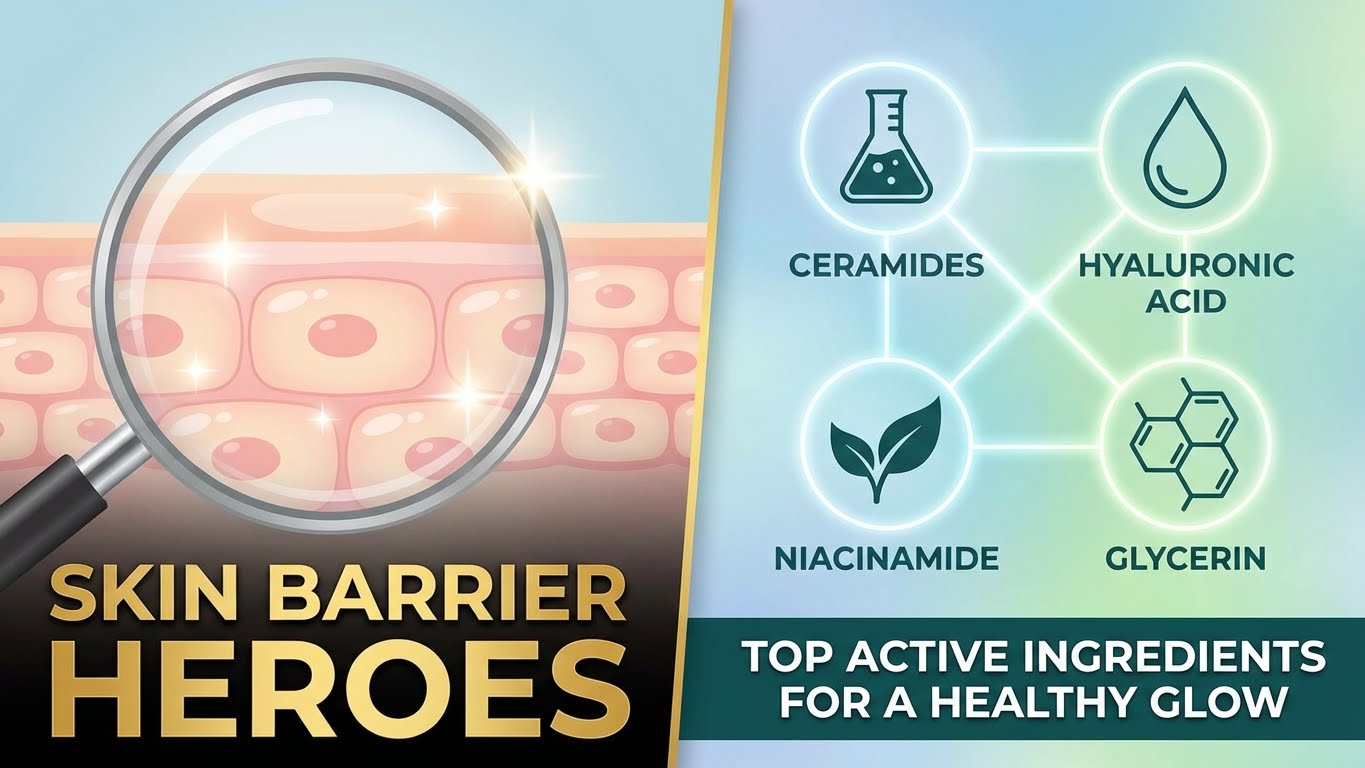
If you have ever followed a skincare routine “by the book” and still ended up with dryness, redness, rough skin, or dehydrated skin, this article is for you.
You are not doing skincare wrong. You are likely expecting the wrong things from the right ingredients.
Modern skincare teaches us to chase ingredients. One for hydration. One for glow. One for pores. One for repair. But skin does not work in isolation, and neither do ingredients. When the skin barrier is ignored, even the most celebrated actives can leave skin feeling irritated, fragile, and confused.
This article is written for the Intentional Glow-Getter, someone who wants calm, resilient, healthy skin for the long term. If you want to understand what ingredients like hyaluronic acid, ceramides, niacinamide, and vitamin C actually do, what they cannot do, and how to use them without damaging your skin health barrier, you are in the right place.
By the end, you will know exactly what to expect from your skincare and how to build glow without stress.
Why your skin barrier decides whether ingredients work
Your skin barrier is the outermost layer of your skin. Its job is simple but vital: to keep water in and keep irritants out.
When the barrier is healthy, skin feels smooth, calm, and balanced. When it is damaged, moisture escapes, sensitivity increases, and inflammation becomes easier to trigger. This is why dryness, redness, rough skin, and dehydrated skin often appear together. They are not separate problems, but signs of a damaged skin barrier.
Dermatology research shows that increased water loss through the skin often happens before you see irritation or redness. In other words, barrier damage begins quietly, long before skin “acts up”.
This is why ingredients behave differently depending on your barrier state. The same serum can feel soothing on healthy skin and stinging on stressed skin. Context matters more than concentration.
Hyaluronic acid: hydration, not repair
Hyaluronic acid is best known for hydration. It attracts water and helps skin feel plump and comfortable. This makes it incredibly useful, but also easy to misunderstand.
Hyaluronic acid does not repair the skin barrier. It does not stop water from escaping the skin. It only holds onto water that is already there.
When the skin barrier is healthy, hyaluronic acid boosts hydration beautifully. When the barrier is damaged, it can give short-term relief without fixing the root problem. In very dry environments, or when used without barrier lipids, it can even make skin feel more dehydrated over time.
Clinical studies show that humectants like hyaluronic acid work best when paired with ingredients that reduce water loss, such as ceramides and fatty acids.
What to expect:
Hyaluronic acid helps dehydrated skin feel softer and more comfortable, but only when the barrier is supported. It is a helper, not a healer.
Ceramides: the backbone of the skin barrier
Ceramides are lipids that naturally make up almost half of a healthy skin barrier. They are not trendy ingredients, they are structural ones.
When ceramide levels drop, the barrier becomes leaky. Water escapes more easily. Irritants get in more easily. Skin becomes dry, rough, and reactive.
Research consistently shows that people with eczema, sensitive skin, and chronic dryness have lower ceramide levels, even when symptoms look mild.
This is why ceramides do not create instant glow. They create stability. Over time, they help skin hold hydration, reduce redness, and tolerate active ingredients again.
What to expect:
Ceramides rebuild the skin health barrier slowly and quietly. The reward is skin that feels calmer, stronger, and more resilient week by week.
This is why barrier-first moisturisers like Enaglow’s Dermal Restore, formulated with ceramides and supportive lipids, are designed to support recovery, rather than overwhelm skin.
Niacinamide: barrier helper or hidden stressor?
Niacinamide (vitamin B3) is one of the most researched skincare ingredients. It supports ceramide production, improves barrier strength, and helps reduce redness.
So why does it irritate some people? The answer is not that niacinamide is “bad”. It is that damaged skin absorbs ingredients faster and reacts more strongly.
At moderate levels, niacinamide supports barrier repair. At higher levels, especially on compromised skin, it can cause flushing or stinging. Research shows that niacinamide improves barrier function best when the skin is stable enough to process it properly.
What to expect:
Niacinamide helps calm redness and strengthen the skin barrier when used gently and in the right context. It is not meant to force results on stressed skin.
This is why Enaglow uses measured, barrier-supportive concentrations, allowing niacinamide to assist repair rather than provoke irritation.
Vitamin C: glow comes with conditions
Vitamin C is powerful, but it is also demanding.
The most studied form, L-ascorbic acid, works at a low pH. This acidity helps penetration but can temporarily disrupt the skin barrier and increase water loss. Healthy skin can adapt to this. Damaged skin often cannot.
Research shows that low-pH formulas can increase transepidermal water loss before the skin adjusts, explaining why vitamin C often stings on sensitive or dehydrated skin.
Gentler vitamin C derivatives exist, but even they should be used with respect for barrier health.
What to expect:
Vitamin C supports brightness and skin health only when the barrier is ready. When the barrier is damaged, it is often better to pause vitamin C and focus on repair first.
Glow is a reward for healthy skin, not a shortcut.
The ingredients that make everything work better
Great skincare is not built on single hero ingredients. It is built on balance.
Cholesterol and fatty acids help complete the lipid matrix of the skin barrier. Panthenol helps reduce water loss and calm inflammation. Peptides support repair signals over time. Ectoin helps protect skin from environmental stress.
Studies show that these supporting ingredients improve barrier function and reduce irritation when used together. This is why Enaglow formulations focus on synergy, not stacking actives. Skin repairs best when it feels safe.
The biggest skincare myth: stronger means better
Many people fall into the same cycle: irritation appears, so they exfoliate more or add stronger actives. This weakens the barrier further, leading to more redness, more dryness, and more frustration.
Dermatology literature shows that repeated irritation slows barrier recovery and increases long-term sensitivity. Barrier-first skincare flips this mindset. Calm comes first. Strength comes next. Optimisation follows naturally.
What to expect based on your barrier state
When your skin barrier is healthy, ingredients feel gentle and effective. Skin recovers quickly and tolerates change.
When the barrier is damaged, even “good” ingredients can sting. This is not failure, it is feedback.
In these moments, skin benefits most from ceramides, gentle hydration, soothing ingredients, and time. Once stability returns, actives can be reintroduced slowly and safely.
This is the philosophy behind Enaglow’s barrier-first system, supporting skin health so results last.
The quiet truth about great skin
Great skin is not built by chasing trends. It is built by understanding how skin works.
When the skin health barrier is supported, hydration lasts longer. Redness fades. Rough skin smooths. Glow becomes natural, not forced.
At Enaglow, we believe glow is not something you push for.
It is something you earn through care, patience, and respect for your skin.
And now, you know what to expect.
References
Rosso JD, Zeichner J, Alexis A, Cohen D, Berson D. Understanding the Epidermal Barrier in Healthy and Compromised Skin: Clinically Relevant Information for the Dermatology Practitioner: Proceedings of an Expert Panel Roundtable Meeting. J Clin Aesthet Dermatol. 2016 Apr;9(4 Suppl 1):S2-S8. Epub 2016 Apr 1. PMID: 28936279; PMCID: PMC5608132.
https://pmc.ncbi.nlm.nih.gov/articles/PMC5608132/
Simon G. Danby, Paul V. Andrew, Linda J. Kay, Abigail Pinnock, John Chittock, Kirsty Brown, Samuel F. Williams, Michael J. Cork, Enhancement of stratum corneum lipid structure improves skin barrier function and protects against irritation in adults with dry, eczema‐prone skin, British Journal of Dermatology, Volume 186, Issue 5, 1 May 2022, Pages 875–886,
https://academic.oup.com/bjd/article/186/5/875/6705669
Del Rosso JQ, Kircik L. Skin 101: Understanding the Fundamentals of Skin Barrier Physiology-Why is This Important for Clinicians? J Clin Aesthet Dermatol. 2025 Feb;18(2):7-15. PMID: 40078856; PMCID: PMC11896616.
https://pmc.ncbi.nlm.nih.gov/articles/PMC11896616/
Bissett DL, Oblong JE, Berge CA. Niacinamide: A B vitamin that improves aging facial skin appearance. Dermatol Surg. 2005 Jul;31(7 Pt 2):860-5; discussion 865. doi: 10.1111/j.1524-4725.2005.31732. PMID: 16029679.
https://pubmed.ncbi.nlm.nih.gov/16029679/
Telang PS. Vitamin C in dermatology. Indian Dermatol Online J. 2013 Apr;4(2):143-6. doi: 10.4103/2229-5178.110593. PMID: 23741676; PMCID: PMC3673383.
https://pmc.ncbi.nlm.nih.gov/articles/PMC3673383/
Lin TK, Zhong L, Santiago JL. Anti-Inflammatory and Skin Barrier Repair Effects of Topical Application of Some Plant Oils. Int J Mol Sci. 2017 Dec 27;19(1):70. doi: 10.3390/ijms19010070. PMID: 29280987; PMCID: PMC5796020.
https://pmc.ncbi.nlm.nih.gov/articles/PMC5796020/
Graf R, Anzali S, Buenger J, Pfluecker F, Driller H. The multifunctional role of ectoine as a natural cell protectant. Clin Dermatol. 2008 Jul-Aug;26(4):326-33. doi: 10.1016/j.clindermatol.2008.01.002. PMID: 18691511.
https://pubmed.ncbi.nlm.nih.gov/18691511/
Lodén M. Effect of moisturizers on epidermal barrier function. Clin Dermatol. 2012 May-Jun;30(3):286-96. doi: 10.1016/j.clindermatol.2011.08.015. PMID: 22507043.
https://pubmed.ncbi.nlm.nih.gov/22507043/
Share:
Myths vs Truths Around “Natural”, “Clean”, and “Organic” Skincare