

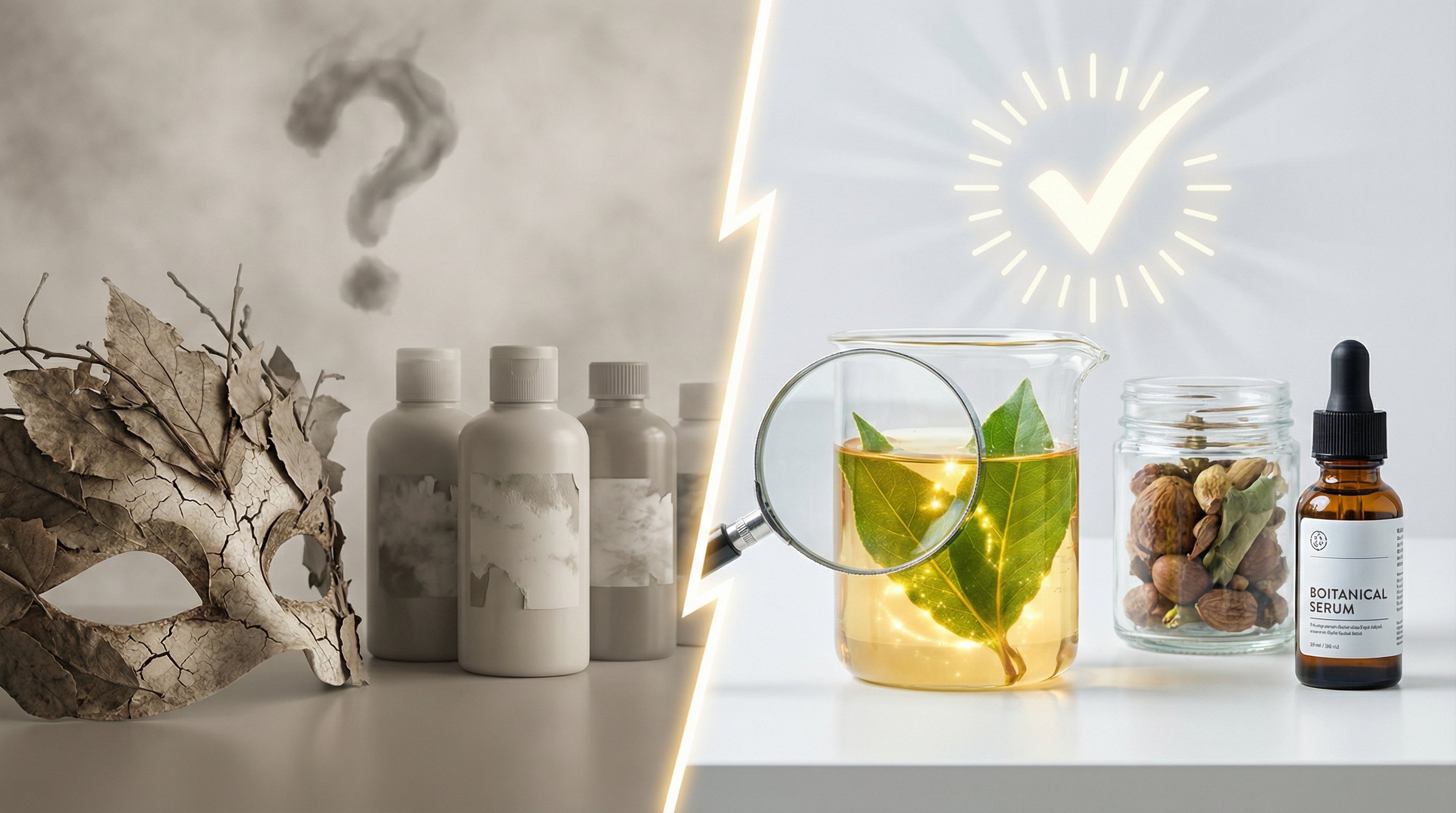
If you have ever picked up a skincare product and felt safer just because it said “natural”, “clean”, or “organic”, you are not alone.
These words sound comforting. They suggest purity, safety, and long-term skin health. For many people, they also promise protection from “toxins”, from harsh chemicals, and from doing harm to their skin.
And yet, dermatologists see the same pattern every day: people using beautifully branded “clean” skincare while struggling with dryness, redness, rough skin, or dehydrated skin. In many cases, the skin barrier is quietly breaking down, even though the products look gentle on the surface.
This article is for the Intentional Glow-Getter who wants clarity, not fear. If you care about skin health, want to protect your skin health barrier, and are tired of confusing marketing language, this guide will help you separate myth from truth, calmly, clearly, and without judgement.
Why “natural” skincare feels safer, and why that matters
The appeal of natural, clean, and organic skincare is emotional before it is scientific. Most people are not afraid of ingredients. They are afraid of long-term harm. They worry about damaging their skin barrier, ageing faster, or unknowingly doing something wrong that will show up years later.
The clean beauty movement grew out of this fear, and in many ways, it was understandable. People wanted transparency. They wanted to trust what they put on their skin. The problem is that in cosmetics, terms like “natural” and “clean” are not tightly regulated. Unlike medicines, there is no universal definition that guarantees gentleness, safety, or suitability for sensitive skin.
This is where confusion begins, and where skin health often suffers.
The truth your skin barrier already knows
Your skin barrier does not understand marketing language. It does not recognise whether an ingredient comes from a plant or a lab. What it responds to is biology: pH, concentration, molecular structure, formulation balance, and how stressed or healthy your skin already is.
Dermatology research shows that barrier damage happens when the outer layer of the skin loses its ability to hold water and block irritants. This leads to increased water loss, inflammation, and sensitivity, the root of dryness, redness, rough skin, and dehydrated skin.
Whether an ingredient is “natural” has very little to do with whether it protects or disrupts this process.
Myth 1: “Natural ingredients are always gentler on skin”
This is one of the most common and most damaging beliefs in skincare.
In reality, many natural ingredients are potent chemical compounds. Essential oils, citrus extracts, fragrant plant resins, and botanical actives contain molecules that can irritate the skin barrier, especially with repeated use.
Studies show that fragrance components, many of which are plant-derived, are among the most common causes of contact dermatitis and skin sensitisation. When the skin barrier is already weakened, these ingredients penetrate more easily, increasing the risk of redness, stinging, and long-term sensitivity.
Uncommon but important truth:
Natural ingredients often contain many active molecules at once. This makes them harder to control and more likely to overwhelm compromised skin.
Gentle skincare is not defined by origin. It is defined by formulation and dose.
Myth 2: “Clean skincare means non-toxic skincare”
The word “toxic” is powerful and often misused.
In toxicology, toxicity is not about whether a substance exists. It is about dose, exposure, and context. Even water can be toxic at the wrong dose.
Dermatology and cosmetic safety rely on decades of toxicological testing to determine safe use levels for ingredients, whether natural or synthetic.
“Chemical-free” skincare does not exist. Everything, including water and plant extracts, is made of chemicals.
Uncommon but valuable insight:
Fear-based ingredient lists often ignore exposure levels. Many “clean beauty bans” exclude ingredients that are safe at cosmetic doses, while allowing natural substances that are far more irritating to the skin barrier.
Skin health improves with evidence-based safety, not fear.
Myth 3: “Organic skincare is better for skin health”
“Organic” refers to how an ingredient is grown, not how it behaves on skin. An organic plant extract can still irritate, sensitise, or destabilise a formulation. It can still disrupt the skin barrier if the pH is wrong or the concentration is too high.
Research shows that skin compatibility depends far more on formulation design and barrier interaction than farming methods. Organic ingredients can be lovely additions to skincare. They are not automatically safer, gentler, or more effective.
Uncommon truth:
Poorly preserved “natural” products can increase microbial growth, which itself can trigger barrier inflammation and irritation.
Skin health requires stability, not just purity.
Myth 4: “If a product is clean, it can’t damage your skin barrier”
This is where many people get stuck. A skincare routine can be labelled clean and still damage the skin's health barrier through over-exfoliation, low pH, frequent product switching, or repeated irritation.
Dermatology studies show that barrier damage often happens gradually, through cumulative stress, not dramatic reactions. When this happens, symptoms are often misread as “detox” or “purging”, when in reality the skin barrier is asking for rest.
Uncommon but crucial insight:
Skin barrier damage often feels like “my skin suddenly hates everything”. This is not sensitivity appearing out of nowhere, it is delayed barrier breakdown.
Myth 5: “Synthetic ingredients are bad for long-term skin health”
Some of the most barrier-supportive ingredients in modern skincare are synthetic by design, created to mimic what healthy skin already uses.
Ceramides, niacinamide, panthenol, peptides, and cholesterol are all examples of ingredients with strong evidence for supporting barrier repair and skin health.
These ingredients are often synthesised to ensure purity, stability, and predictable behaviour on skin, something many natural extracts cannot guarantee.
Uncommon truth:
Synthetic does not mean artificial to the skin. Many synthetic ingredients are skin-identical, making them easier for the barrier to recognise and use.
What actually matters more than labels
Once you remove ideology from skincare, the picture becomes much clearer.
Skin health depends on:
- Barrier structure and lipid balance
- pH and formulation gentleness
- Ingredient concentration and synergy
- How stressed or healthy your skin already is
This is why Enaglow takes a barrier-first approach. Instead of chasing trends, formulations are designed to support calm, resilient skin — using the best of both nature and science, without fear-based marketing.
Products like Dermal Restore and Radiance Shield are designed to strengthen the skin barrier with ceramides and supportive lipids, helping skin recover from dryness and irritation caused by over-exposure to “gentle-sounding” but stressful routines.
How to read skincare labels like an Intentional Glow-Getter
The most empowered skincare users do not look for buzzwords. They look for function.
Rather than asking “Is this natural?”, ask:
- Will this help my skin barrier hold water?
- Is this likely to calm or stimulate my skin?
- Is my skin currently strong enough for this ingredient?
Green flags include barrier-supportive lipids, soothing agents, and formulations that respect skin pH. Red flags are routines that promise fast results through intensity rather than repair.
Knowledge removes fear. Understanding replaces confusion.
Enaglow’s perspective: skin health over skincare ideology
At Enaglow, we believe healthy skin is built, not forced. We do not believe in “clean vs synthetic”. We believe in skin health vs skin stress. Every formulation decision is guided by one question: Does this support the skin barrier long-term?
Glow is not created by avoiding ingredients. It is created by understanding them.
The real truth about natural, clean, and organic skincare
The safest skincare is not the one with the most comforting labels. It is the one that respects your biology.
When the skin barrier is protected, hydration lasts longer. Redness fades. Rough skin smooths. Dehydrated skin regains comfort.
You do not need fear to care for your skin. You need clarity.
And that is the truth that lasts.
References
Hirata, Daniela & Rocha, Eliane & Nogueira, Ronei & Herek, Luciana & Fernanda Felipe, Daniele. (2022). Natural and organic cosmetics: Beneficial properties for the environment and health. International Journal of Advanced Engineering Research and Science. 9. 276-281. 10.22161/ijaers.911.34.
Urban K, Giesey R, Delost G. A Guide to Informed Skincare: The Meaning of Clean, Natural, Organic, Vegan, and Cruelty-Free. J Drugs Dermatol. 2022 Sep 1;21(9):1012-1013. doi: 10.36849/JDD.6795. PMID: 36074502.
Shim, J., Woo, J., Yeo, H., Kang, S., Kwon, B., Jung Lee, E., Oh, J., Jeong, E., Lim, J., & Gyoo Park, S. (2024). The Clean Beauty Trend Among Millennial and Generation Z Consumers: Assessing the Safety, Ethicality, and Sustainability Attributes of Cosmetic Products. Sage Open, 14(2).
Rubin CB, Brod B. Natural Does Not Mean Safe—The Dirt on Clean Beauty Products. JAMA Dermatol. 2019;155(12):1344–1345. doi:10.1001/jamadermatol.2019.2724
Alnuqaydan AM. The dark side of beauty: an in-depth analysis of the health hazards and toxicological impact of synthetic cosmetics and personal care products. Front Public Health. 2024 Aug 26;12:1439027. doi: 10.3389/fpubh.2024.1439027. PMID: 39253281; PMCID: PMC11381309.
Beatriz, C., Huma, H., Amélia, V., Sachin S., Kamal, D., Francisco, V., Patrícia, P., Laura, F., Ana, P., (2025). Promoting health and sustainability: exploring safer alternatives in cosmetics and regulatory perspectives. Sustainable Chemistry and Pharmacy. Volume 43, 2025. 101901, ISSN 2352-5541.
Neill US. Skin care in the aging female: myths and truths. The Journal of Clinical Investigation. 2012 Feb;122(2):473-7. doi: 10.1172/JCI61978. Epub 2012 Feb 1. PMID: 22293186; PMCID: PMC3266803.
Kayal, Sharmila & Saha, Ruma. (2023). Decoding the myth of luxury in cosmetics herbal products advertisements. RUDN Journal of Studies in Literature and Journalism. 28. 175-186. 10.22363/2312-9220-2023-28-1-175-186.
The Art of Healthy Living: Myth vs. Fact: Dispelling Common Misconceptions About Organic And Natural Cosmetics (2023)
Forbes: 11 Skincare Myths You Should Stop Believing, According To Dermatologists (2020)
Revite Nourishments: Skincare Myths Debunked: What You Should Stop Believing (2025)
The London Dermatology Centre: Sustainable Skincare: What ‘Eco’, ‘Clean’, and ‘Natural’ Really Mean A Dermatologist’s View (2025)
Medical News Today: What is organic skin care and how is it different? (2025)
Share:
What to Expect from Hyaluronic Acid, Ceramides, Niacinamide, Vitamin C and More