

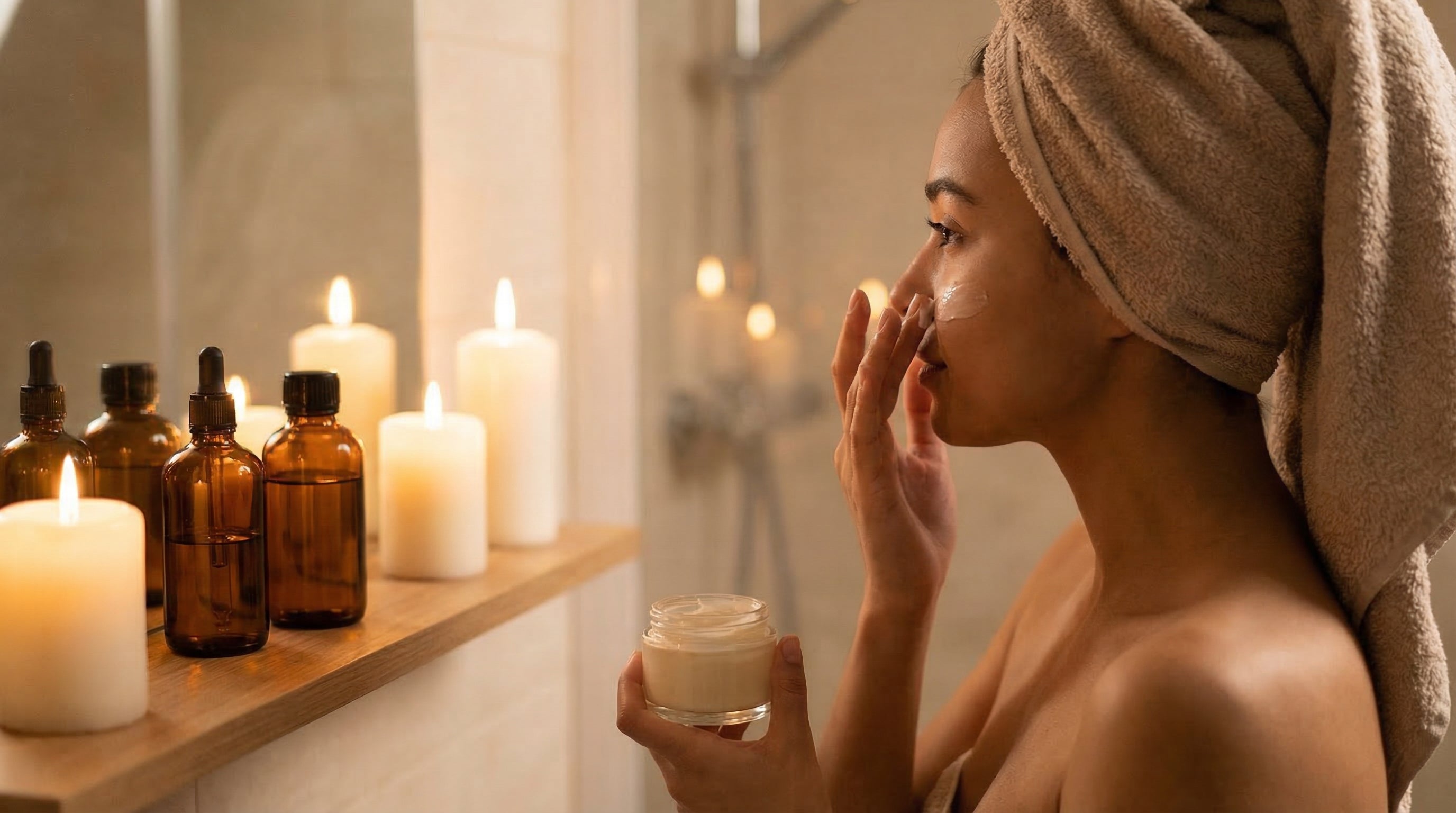
HOW TO REPAIR, STRENGTHEN, AND CARE FOR YOUR SKIN WHILE YOU SLEEP
Your skin isn’t failing. It’s asking for repair.
If your skin suddenly feels tight… If your usual products start to sting… If you see dryness, redness, or rough skin that won’t go away…
Your skin barrier is likely damaged.
And here’s the part most people miss: Your skin does not repair itself during the day. It repairs at night.
This article will show you exactly how to use that window to repair, strengthen, and protect your skin barrier, using simple, science-backed steps.
If you’ve been stuck in a cycle of irritation, dehydrated skin, or dullness… this is where it changes.
WHY YOUR SKIN BARRIER ISN’T HEALING (YET)
Most people don’t lack products. They lack the right timing and structure. A damaged skin barrier means the outer layer of your skin is no longer holding water in or keeping irritants out. This increases transepidermal water loss (TEWL), a key marker of barrier damage.
When TEWL rises:
- Skin becomes dry and dehydrated
- Redness and sensitivity increase
- Even gentle products can sting
Here’s the mistake: Trying to “fix” damaged skin with stronger actives, which delays healing.
Research shows the skin barrier depends on a precise balance of lipids, mainly ceramides, cholesterol, and fatty acids, arranged like mortar between bricks.
If that structure is not restored first, nothing else works properly.
WHAT HAPPENS TO YOUR SKIN AT NIGHT (THIS CHANGES EVERYTHING)
At night, your skin shifts into repair mode.
This is not a trend. It’s biology.
- Skin cell turnover increases during the night cycle
- Blood flow to the skin rises, improving nutrient delivery
- The barrier becomes more permeable, meaning it can absorb products better
But there’s a catch: Your skin is also more vulnerable at night. So, what you apply can either accelerate repair or worsen damage. This is why your night routine matters more than your morning routine.
THE 3 STATES OF YOUR SKIN BARRIER (KNOW THIS FIRST)
Before building a routine, you need to know where your skin is:
1. Repair Mode (Damaged skin barrier)
Skin feels tight, irritated, reactive
→ Focus: calm + rebuild
2. Strength Mode (Recovering barrier)
Skin is stable but not fully resilient
→ Focus: reinforce + hydrate
3. Optimise Mode (Healthy barrier)
Skin is smooth, glowing, and tolerant
→ Focus: renewal + refinement
Most people try to jump straight to optimise. But real results come from respecting the order.
THE BEST NIGHT ROUTINE FOR SKIN BARRIER REPAIR
This is where everything comes together.
Step 1: Cleanse without stripping
At night, cleansing removes pollutants, sunscreen, and oil. But harsh cleansers damage lipids and worsen barrier loss. Barrier research shows that over-cleansing disrupts lipid organisation and increases TEWL.
Use a gentle cleanser that leaves skin feeling soft, not tight.
Step 2: Rehydrate (before you repair)
Water loss is one of the first signs of a damaged skin barrier. Humectants like glycerin and hyaluronic acid draw water into the skin and improve hydration levels.
Think of this step as “refilling the tank.” Without water, repair cannot happen.
Step 3: Treat (only if your skin is ready)
Here’s a rule most routines ignore:
Do not use strong actives on a damaged skin barrier.
If your skin is still in repair mode:
→ Skip exfoliants and strong retinoids
Once your skin is stable:
→ You can introduce controlled renewal
Retinal (vitamin A derivative) supports cell turnover and improves skin texture when used correctly.
This is where a formula such as Retinal Reset fits, designed to support renewal without overwhelming the barrier.
Step 4: Repair the barrier (this is the core step)
This is the most important part of your night routine. To repair a damaged skin barrier, you must replace the lipids it has lost. Clinical research shows that moisturisers containing:
- ceramides
- cholesterol
- fatty acids
can restore barrier function and reduce TEWL more effectively than basic hydration alone.
Step 5: Seal and protect overnight
At night, your skin loses more water because there is no environmental protection.
Using a well-formulated moisturiser creates a protective layer that:
- reduces water loss
- supports overnight repair
- improves skin texture by morning
This is not about heaviness. It’s about locking in recovery.
Steps 4 and 5 are where a barrier-focused cream like Dermal Restore becomes essential.
It works by replenishing lost lipids, improving hydration, and supporting long-term skin resilience while creating a protective barrier layer over the skin, which locks in moisture.
THE MISTAKES KEEPING YOUR SKIN BARRIER DAMAGED
If your skin isn’t improving, one of these is likely happening:
- Using actives on irritated skin
- Skipping moisturiser (common with oily skin types)
- Over-cleansing or double cleansing aggressively
- Mixing too many treatments
- Chasing the glow before repairing the barrier
The truth: Glow is not created. It is revealed once the barrier is healthy.
THE INGREDIENTS THAT TRULY REPAIR YOUR SKIN BARRIER
If you remember nothing else, remember this: A healthy skin barrier needs structure, water, and protection. The most effective ingredients are:
- Ceramides → rebuild barrier structure
- Cholesterol → stabilises lipid layers
- Fatty acids → restore flexibility
- Glycerin / Hyaluronic acid → increase hydration
- Panthenol & beta-glucan → calm and support recovery
- Niacinamide → improves barrier function and reduces visible redness
These are not trends. They are the foundation of skin health.
HOW LONG DOES IT TAKE TO REPAIR A DAMAGED SKIN BARRIER?
This is where patience matters.
- A few days → less irritation
- 2–4 weeks → stronger barrier function
- Long-term → more resilient, glowing skin
Barrier recovery depends on consistency. There is no shortcut. But there is a clear path.
THE REAL SECRET TO HEALTHY, GLOWING SKIN
Most routines focus on what you can see. But skin health starts with what you can’t see, the barrier. When your skin barrier is strong, hydration stays in, irritants stay out, actives work better, and glow becomes natural.
This is the philosophy behind Enaglow:
Repair first. Strengthen next. Optimise last.
And when you follow this at night, consistently, you stop fighting your skin…
…and start working with it.
Share: