

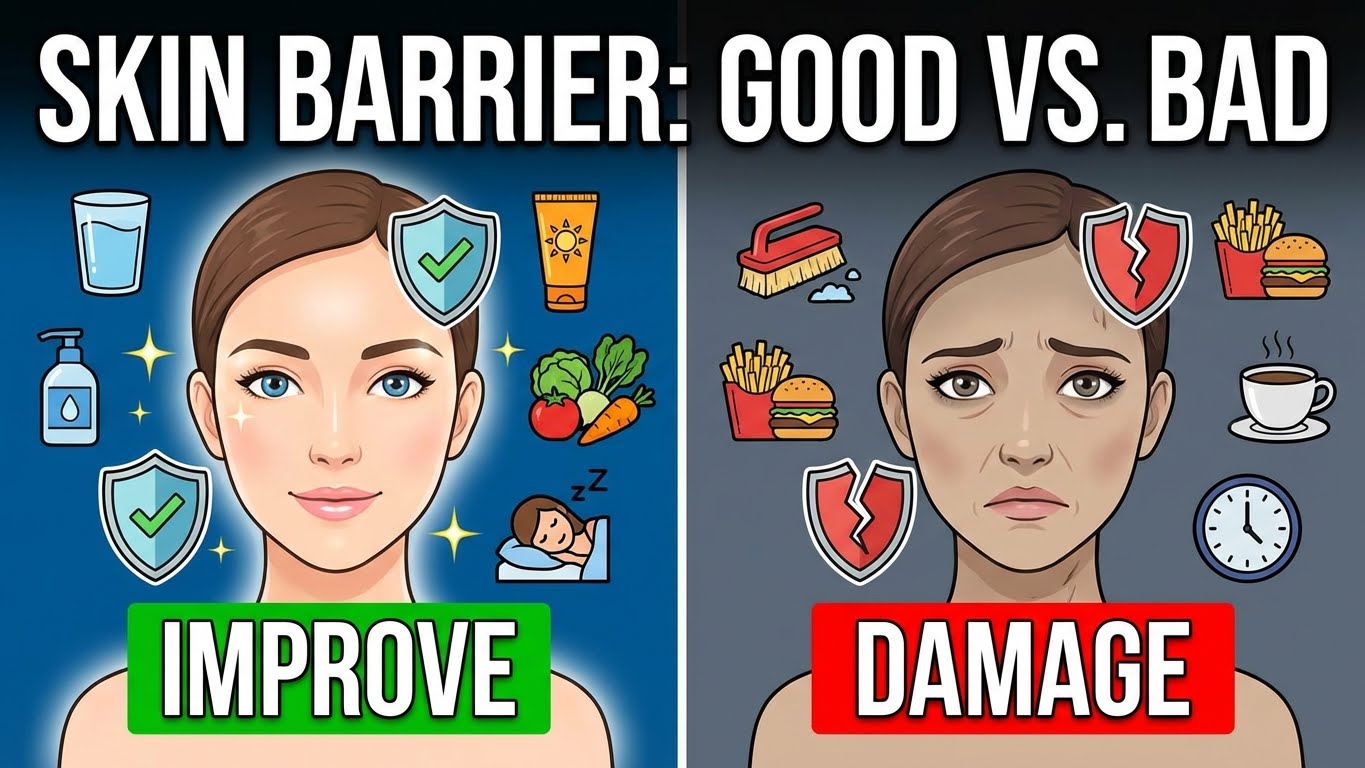
When Your Skin Stops Feeling Like Yours
Your skin used to feel calm, smooth, and easy. Then something changed. Now it stings when you apply products. It feels tight after washing. You notice redness, dryness, rough patches… even when you’re doing “everything right.”
If this sounds familiar, you’re not alone. And more importantly, you’re not doing skincare wrong. You’re likely dealing with a weak or damaged skin barrier.
This article will help you understand:
- What your skin barrier really is
- Why it becomes damaged (even with good skincare)
- How to recognise the signs early
- And exactly how to repair and strengthen it, properly
Because once you understand this, everything about your skin starts to make sense.
You can also download this quick Barrier Reset Plan to keep you honest on busy days.
What Is The Skin Barrier (And Why It Matters More Than You Think)?
Your skin barrier is your skin’s frontline defence system. It lives in the outermost layer of your skin, called the stratum corneum. This layer acts like a protective shield between your body and the outside world. Think of it like a wall. Not just any wall, a “brick and mortar” structure.
- The “bricks” are your skin cells
- The “mortar” is made of lipids, mainly ceramides, cholesterol, and fatty acids
These lipids are not random. They exist in a very specific balance, roughly 3:1:1 ratio, which is essential for keeping your skin healthy and hydrated.
When this structure is intact, your skin can:
- Hold onto water
- Keep irritants out
- Stay smooth, calm, and resilient
But when this structure breaks down… everything changes.
What Happens When Your Skin Barrier Is Damaged?
A damaged skin barrier doesn’t fail quietly. It leaks. Scientifically, this is called transepidermal water loss (TEWL), when water escapes from your skin faster than it should. As TEWL increases, your skin begins to struggle to maintain balance.
You may notice:
- Dryness that doesn’t go away (or keeps coming back)
- Redness or sensitivity
- A tight feeling after cleansing
- Rough or flaky skin
- Products suddenly stinging
This happens because your skin is no longer protecting you properly. According to dermatology research, when the barrier is compromised, it leads to:
- Increased water loss
- Altered lipid structure
- Higher sensitivity to irritants and environmental stressors
In simple terms:
Your skin becomes reactive instead of resilient.
The Hidden Reasons Your Skin Barrier Becomes Weak
Here’s where most people get it wrong. They think their skin is “just sensitive” or “just dry.” But in reality, your barrier has been slowly pushed out of balance.
1. Overuse of Actives: Too many exfoliants. Too much retinol. Too many acids. Even good ingredients can damage your skin when used at the wrong time.
2. Harsh Cleansing: Stripping cleansers remove not just dirt, but also essential lipids your barrier needs.
3. Low Humidity & Environment: Cold weather, indoor heating, and pollution all weaken the barrier over time.
4. Poor Lipid Replenishment: Your skin needs ceramides, cholesterol, and fatty acids, but most routines don’t replace them properly.
5. Internal Factors: Ageing, genetics, and even diet can affect your skin barrier.
For example, essential fatty acids can come from your diet, and deficiencies can directly increase water loss and lead to dermatitis-like symptoms.
A Crucial Insight Most People Don’t Know
Your skin barrier is not static. It is constantly repairing itself. In fact, your skin can shed up to 50,000 cells per minute while maintaining this barrier.
But here’s the catch: Repair only works if the right building blocks are available.
If your skin lacks lipids, hydration, or the right conditions… repair slows down, or fails completely. This is when problems become chronic.
The Two Modes of Your Skin (That Change Everything)
To truly understand your skin, you need to see it in two modes:
Repair Mode
This is when your barrier is damaged. Your skin needs:
- Calm
- Hydration
- Lipid replenishment
Not more actives.
Strength Mode
Once your barrier is stable again, your skin can:
- Tolerate actives
- Renew faster
- Hold hydration better
Most people skip straight to strengthening. That’s why their skin never improves long-term.
How to Repair a Weak Skin Barrier (The Right Way)
This is where everything starts to shift. Repair is not about doing more. It’s about doing less, but better.
Step 1: Reduce Stress on the Skin
Simplify your routine.
Remove:
- Strong exfoliants
- Harsh actives
- Overcomplicated layering
Your skin needs space to recover.
Step 2: Rebuild the Lipid Matrix
Remember the “mortar” between your skin cells? This needs to be restored. Look for ingredients like:
- Ceramides
- Cholesterol
- Fatty acids
These help rebuild the structure that holds your skin together. This is exactly the kind of support found in Enaglow’s Dermal Restore, designed to replenish barrier lipids and restore comfort to stressed skin.
Step 3: Restore Hydration Deeply
Hydration is not just surface-level. Your skin contains natural moisturising factors (NMF) — compounds like amino acids and urea that help retain water inside the skin. When these are low, skin becomes dehydrated and fragile.
Ingredients like:
- Hyaluronic acid
- Glycerin
- Panthenol
help restore this internal hydration.
Step 4: Support Long-Term Barrier Function
Once your skin starts to feel calm again, you can begin strengthening. This is where antioxidant support becomes important. Vitamin C, peptides, and niacinamide help:
- Protect against environmental damage
- Support skin renewal
- Improve resilience over time
This is the role of Radiance Shield, supporting your skin once it’s ready to hold onto glow again.
Another Insight: Not All Moisturisers Are Equal
Here’s something rarely discussed. Some moisturisers only sit on the surface. Others actually change how your skin functions. Research shows that certain formulations can:
- Improve lipid organisation
- Reduce TEWL
- Lower irritation risk over time
But others can do the opposite, even worsening barrier function. This is why formulation matters more than marketing.
The Truth Most Brands Won’t Tell You
More products won’t fix your skin. Better order will.
Repair → Strengthen → Optimise
If you skip the first step, nothing else works properly. This is the foundation of Enaglow’s barrier-first philosophy.
Final Thoughts: Your Skin Isn’t Failing - It’s Asking for Help
If your skin feels off, sensitive, or unpredictable… It’s not random. It’s communication.
Your skin is telling you:
- It needs protection
- It needs rebuilding
- It needs time
When you listen and respond the right way, everything changes. Your skin becomes stronger, calmer, and more radiant.
Not because you added more… But because you finally gave it what it actually needed.
Don’t forget to download the Enaglow Barrier Reset Plan to support you every day.
References (Bibliography)
- Tharakan M, Lonczak L. Supporting Skin Structure and Its Barrier Functions with Evidence-Based Skin Care Ingredients. Journal of Cosmetics, Dermatological Sciences and Applications, 2024.
- Del Rosso JQ et al. Understanding the Epidermal Barrier in Healthy and Compromised Skin. Journal of Clinical and Aesthetic Dermatology, 2016.
- Lodén M. Treatments Improving Skin Barrier Function. Current Problems in Dermatology, 2016.
Share:
Why Postbiotics and Fermented Ingredients are the Future of Your Skin
Guide to Choosing the Best Cleanser for Your Skin Barrier